
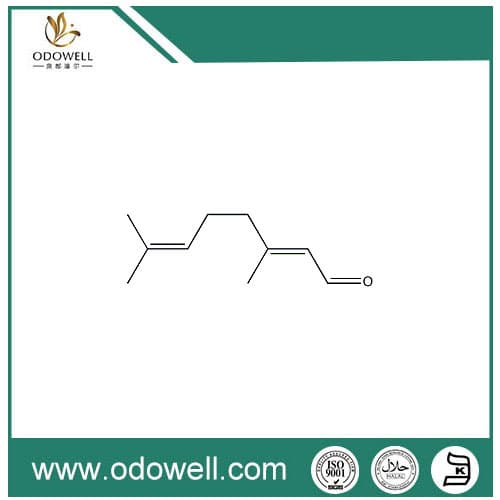
Citral
Citral's cas code is 5392-40-5
Citral, Suppliers, Wholesale, In Stock, Free Sample, China, Manufacturers, Made in China, Low Price, Quality, 1 Year Warranty
Product Description
Citral Basic information
Overview Toxicity Usage limits Chemical Properties Application Production method
Product Name: | Citral |
Synonyms: | 6-Octadienal,3,7-dimethyl-2;cis,trans-Citral;cis-Citral;Citral (cis and trans);Citral acis-3,7-dimethyl-2,6-octadienal;Citral,c&t;citral,mixtureofcisandtrans;femanumber2303 |
CAS: | 5392-40-5 |
MF: | C10H16O |
MW: | 152.23 |
EINECS: | 226-394-6 |
Product Categories: | |
Mol File: | 5392-40-5.mol |
Citral Chemical Properties
Melting point | <-10°C |
Boiling point | 229 °C(lit.) |
density | 0.888 g/mL at 25 °C(lit.) |
vapor density | 5 (vs air) |
vapor pressure | 0.2 mm Hg ( 200 °C) |
refractive index | n20/D 1.488(lit.) |
FEMA | 2303 | CITRAL |
Fp | 215 °F |
storage temp. | 2-8°C |
solubility | 0.42g/l |
form | Liquid |
color | colorless to light yellow |
explosive limit | 4.3-9.9%(V) |
Water Solubility | PRACTICALLY INSOLUBLE |
JECFA Number | 1225 |
Merck | 14,2322 |
BRN | 1721871 |
Stability: | Stable. but readily isomerizes. Incompatible with alkalies, strong oxidizing agents, strong acids. Combustible. Air and light sensitive. |
CAS DataBase Reference | 5392-40-5(CAS DataBase Reference) |
NIST Chemistry Reference | Citral(5392-40-5) |
EPA Substance Registry System | Citral (5392-40-5) |
Safety Information
Hazard Codes | Xi |
Risk Statements | 38-43 |
Safety Statements | 24/25-37 |
RIDADR | 1760 |
WGK Germany | 1 |
RTECS | RG5075000 |
Autoignition Temperature | 225 °C |
TSCA | Yes |
HS Code | 2912 19 00 |
HazardClass | 8 |
PackingGroup | III |
Hazardous Substances Data | 5392-40-5(Hazardous Substances Data) |
Toxicity | LD50 orally in rats: 4.96 g/kg (Opdyke) |
Citral Usage And Synthesis
Overview | Citral (C10H16O), also called 3,7-dimethyl-2,6-octadienal, a pale yellow liquid, with a strong lemon odour, that occurs in the essential oils of plants. It is insoluble in water but soluble in ethanol (ethyl alcohol), diethyl ether, and mineral oil. It is used in perfumes and flavourings and in the manufacture of other chemicals. Chemically, citral is a mixture of two aldehydes that have the same molecular formula but different structures. |
Toxicity | ADI 0~0.5mg/kg (FAO/WHO, 1994-). LD50 4960 mg/kg (rat, oral); MNL 500 mg/kg. |
Usage limits | FEMA (mg/kg): soft drinks 9.2; cold drinks 23; candy 41; baked goods 43; chewing gums 170 |
Chemical Properties | Colorless or slightly yellow liquid; strong lemon flavor; no optical rotation; boiling point 228 °C; flash point 92 °C; |
Application | Citral is an artificial flavor permitted to use in China, which can be used to prepare strawberries, apples, apricots, sweet orange, lemon and other fruit-based flavors. According to normal production needs, the citrals amount used in chewing gums is 1.70mg/kg; baked goods 43mg/kg; candy 41mg/kg; cold drinks 23mg/kg; soft drinks 9.2mg/kg. |
Production method | Citral natural exists in the litsea cubeba oil (about 80%), lemon grass oil (80%), clove basil oil (65%), sour lemon oil (35%) and lemon oil. In industry, citral can be derived from natural essential oils, or be prepared by chemical. |
Chemical Properties | mobile light yellow liquid with a lemon-like smell |
Chemical Properties | Citral occurs as (2Z)- and (2E)-isomers (citral a and b, respectively) analogous to the corresponding alcohols, geraniol and nerol: geranial (citral a), bp2.7 kPa 118–119 °C, d20 0.8888, n20 D 1.4898; neral (citral b), bp2.7 kPa 120 °C, d20 0.8869, n20 D 1.4869. Natural citral is nearly always a mixture of the two isomers. It occurs in lemongrass oil (up to 85%), in Litsea cubeba oil (up to 75%), and in small amounts inmany other essential oils. The citrals are colorless to slightly yellowish liquids, with an odor reminiscent of lemon. |
Chemical Properties | Citral has a strong, lemon-like odor and a characteristic bittersweet taste. Commercially, the product is a mixture of two geometric isomers—α-citral and β-citral, each exhibiting cis- and trans-isomers because of the position of the double bond. |
Uses | Citral is a liquid flavoring agent, light yellow in color with a citrus odor. it occurs in lemon and lemongrass oils. it is usually obtained from citral-containing oils by chemical means but may also be pre- pared synthetically. it is soluble in fixed oils, mineral oil, and pro- pylene glycol. it is moderately stable and should be stored in glass, tin, or resin-lined containers. it is used in flavors for lemon with applications in candy, baked goods, and ice cream at 20–40 ppm. it is also termed 2,6-dimethyl-octadian-2-6-al-8. |
Uses | Citral is an anti-microbial agent found in plants with antibacterial activity against some food pathogens. It is also a fragrance compound with a distinct lemon scent. |
Uses | citral is a naturally occurring aroma compound used to provide a lemon-type fragrance. Citral is a constituent of lemon oil, lemongrass oil, lime oil, ginger oil, verbena oil, and other plant-derived C essential oils. |
Preparation | Since citral is used in bulk as a starting material for the synthesis of vitamin A, it is produced industrially on a large scale. Smaller quantities are also isolated from essential oils. |
Definition | Commercial material is a mixture of α and β isomers. |
Aroma threshold values | Detection at 1.0%: characterizing lemon-like, distilled lime peel, intense aldehydic citruslike. |
Taste threshold values | Taste characteristics at 5 ppm in 5% sugar and 0.1% CA: characteristic lemon, peely, citrus, green floral juicy with woody and candy notes. |
General Description | A clear yellow colored liquid with a lemon-like odor. Less dense than water and insoluble in water. Toxic by ingestion. Used to make other chemicals. |
Air & Water Reactions | Insoluble in water. |
Reactivity Profile | Citral is an aldehyde. Aldehydes are frequently involved in self-condensation or polymerization reactions. These reactions are exothermic; they are often catalyzed by acid. Aldehydes are readily oxidized to give carboxylic acids. Flammable and/or toxic gases are generated by the combination of aldehydes with azo, diazo compounds, dithiocarbamates, nitrides, and strong reducing agents. Aldehydes can react with air to give first peroxo acids, and ultimately carboxylic acids. These autoxidation reactions are activated by light, catalyzed by salts of transition metals, and are autocatalytic (catalyzed by the products of the reaction). The addition of stabilizers (antioxidants) to shipments of aldehydes retards autoxidation. Citral can react with alkalis and strong acids. Citral can readily isomerize. |
Hazard | Questionable carcinogen. |
Fire Hazard | Citral is combustible. |
Contact allergens | Citral is an aldehyde fragrance and flavoring ingredient, a blend of isomers cis (Neral) and trans (geranial). As a fragrance allergen, citral has to be mentioned by name in cosmetics within the EU. |
Safety Profile | Moderately toxic by intraperitoneal route. Mildly toxic by ingestion. Experimental reproductive effects. A severe human and experimental skin irritant. Mutation data reported. Combustible liquid. When heated to decomposition it emits acrid smoke and irritating fumes. |
Chemical Synthesis | Citral is usually isolated from the citral-containing oil by chemical means or by chemical synthesis (from β-pinene, isoprene, etc.). |
Citral Preparation Products And Raw materials
Preparation Products | Citronellol-->Geraniol-->Citronellal-->NEROL-->Ionone-->3,7-Dimethyl-7-hydroxyoctanal-->BETA-CYCLOCITRAL-->Isophytol-->isodecanal-->alpha-Ionone-->METHYLIONONE-->isometheptene-->DIHYDRO-BETA-IONONE-->IRONE-->ALPHA-ISO-METHYLIONONE-->beta-Damascenone-->3,7-Dimethyl-2,6-octadienenitrile-->1,1-Diethoxy-3,7-dimethylocta-2,6-diene-->4-(2,2-dimethyl-6-methylenecyclohexyl)-3-buten-2-one-->LEMON OIL-->4-(2,6,6-Trimethyl-1-cyclohexenyl)-3-buten-2-one-->ALLYL IONONE |
Raw materials | Sodium bicarbonate-->Sodium bisulfite-->Polyoxyethylene lauryl ether-->SULFUROUS ACID-->Linalool-->Geraniol-->1-OCTENE-->NEROL-->Eucalyptus Citriodara Oil-->LEMONGRASS OIL, WEST INDIAN TYPE-->6-Methyl-5-hepten-2-one-->Ethoxyethyne-->Litsea cubeba oil-->Basil oil-->Citrus Oil-->Verbena Oil-->Hotrienol-->CITRUS LIMETTA OIL-->Lemon leaf oil |