
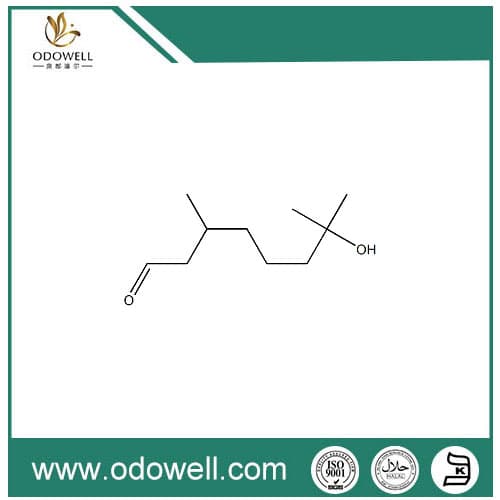
Hydroxycitronellal
Hydroxycitronellal's cas code is 107-75-5
Hydroxycitronellal, Suppliers, Wholesale, In Stock, Free Sample, China, Manufacturers, Made in China, Low Price, Quality, 1 Year Warranty
Product Description
hydroxycitronellal Basic information
Product Name: | hydroxycitronellal |
CAS: | 107-75-5 |
MF: | C10H20O2 |
MW: | 172.26 |
EINECS: | 203-518-7 |
Mol File: | 107-75-5.mol |
hydroxycitronellal Chemical Properties
Melting point | 22-23 °C |
Boiling point | 257 °C(lit.) |
density | 0.923 g/mL at 25 °C(lit.) |
FEMA | 2583 | HYDROXYCITRONELLAL |
refractive index | n20/D 1.448(lit.) |
Fp | >230 °F |
storage temp. | room temp |
pka | 15.31±0.29(Predicted) |
form | Liquid |
Specific Gravity | 0.93 |
color | Clear colorless |
JECFA Number | 611 |
InChIKey | WPFVBOQKRVRMJB-UHFFFAOYSA-N |
CAS DataBase Reference | 107-75-5(CAS DataBase Reference) |
NIST Chemistry Reference | Hydroxycitronellal(107-75-5) |
EPA Substance Registry System | Octanal, 7-hydroxy-3,7-dimethyl- (107-75-5) |
Hydroxycitronellal Safety Information
Hazard Codes | Xi |
Risk Statements | 38-41-43 |
Safety Statements | 26-39-36/37 |
RIDADR | UN1230 - class 3 - PG 2 - Methanol, solution |
WGK Germany | 1 |
RTECS | RG7850000 |
HS Code | 29124990 |
hydroxycitronellal Usage And Synthesis
Description | Hydroxycitronellal has an intense, sweet, floral, lily-type odor. It may be prepared by hydration of natural citronellal obtained from Java citronella or from Eucalyptus citriodora; P-pinene is converted to myrcene, which on hydration may yield either linalool or a mixture of geranoil and nerol; the latter mixture can be hydrogenated to citronellol and subsequently converted to citronellal and hydroxycitronellal; also by hydrogenation of 3,7-dimethyl- 7-hydroxy-2-octen-2-al over palladium carbon in ethyl acetate solution. |
Chemical Properties | Hydroxycitronellal has a sweet, floral, lily-type odor |
Chemical Properties | clear colourless liquid |
Chemical Properties | This is a colorless, slightly viscous liquid with a floral odor reminiscent of linden blossom and lily of the valley. Commercially available “hydroxycitronellal” is either optically active or racemic, depending on the starting material used. Hydroxydihydrocitronellal prepared from (+)-citronellal, for example, has a specific relation α20 D +9 to +10°. |
Definition | ChEBI: The tertiary alcohol arising from addition of water across the C2C double bond of citronellal. |
Taste threshold values | Taste characteristics at 50 ppm: sweet, waxy, green, floral and melon notes. |
Trade name | Laurinal® (Takasago). |
Contact allergens | Hydroxycitronellal is a classical fragrance allergen, found in many products. It is contained in “fragrance mix.” It has to be listed by name in the cosmetics of the EU. |
Safety Profile | A skin irritant. Combustible liquid. When heated to decomposition it emits acrid smoke and irritating fumes. See also ALDEHYDES. |
Chemical Synthesis | By hydration of natural citronellal obtained from Java citronella or from Eucalyptus citriodora; β-pinene is converted to myrcene, which on hydration may yield either linalool or mixture of geranoil and nerol; the latter mixture can be hydrogenated to citronellol and subsequently converted to citronellal and hydroxycitronellal; also by hydrogenation of 3,7-dimethyl-7-hydroxy-2- octen-2-al over palladium carbon in ethyl acetate solution. |
hydroxycitronellal Preparation Products And Raw materials
Raw materials | Sodium bisulfite-->Sodium acetate trihydrate-->SULFATE STANDARD-->Citral-->SULFUROUS ACID-->Citronellal-->Eucalyptus Citriodara Oil-->Citronella oil-->sulfurous acid |
Preparation Products | 8,8-Dimethoxy-2,6-dimethyloctan-2-ol-->HYDROXY CITRONELLAL DIETHYL ACETAL |