
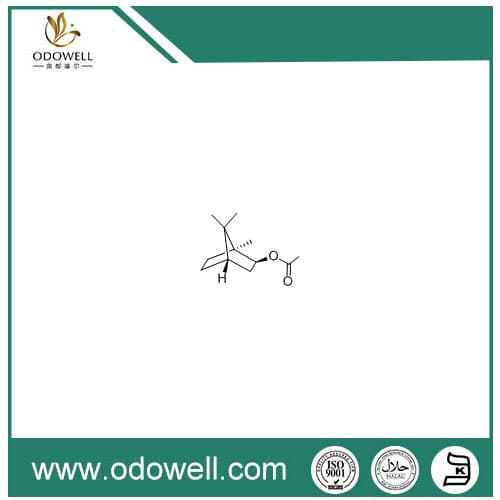
Isobornyl Acetate
Isobornyl acetate;IBA's cas code is 125-12-2
Isobornyl Acetate, Suppliers, Wholesale, In Stock, Free Sample, China, Manufacturers, Made in China, Low Price, Quality, 1 Year Warranty
Product Description
Isobornyl acetate Basic information
Description References
Product Name: | Isobornyl acetate |
Synonyms: | ISOBORNYL ACETATE;BORNYL ACETATE (ISO);2-CAMPHANYL ACETATE;2-BORNANOL:ACETATE, EXO;1,7,7-trimethyl-,acetate,exo-bicyclo(2.2.1)heptan-2-o;1,7,7-trimethyl-,acetate,exo-bicyclo[2.2.1]heptan-2-o;Pichtosine;1,7,7-trimethyl-,acetate,exo-Bicyclo[2.2.1]heptan-2-ol |
CAS: | 125-12-2 |
MF: | C12H20O2 |
MW: | 196.29 |
EINECS: | 204-727-6 |
Product Categories: | FINE Chemical & INTERMEDIATES;Aroma Chemicals;Bicyclic Monoterpenes;Biochemistry;Terpenes;Alphabetical Listings;Flavors and Fragrances;I-L |
Mol File: | 125-12-2.mol |
Isobornyl acetate Chemical Properties
Melting point | 29°C |
Boiling point | 229-233 °C(lit.) |
density | 0.983 g/mL at 25 °C(lit.) |
vapor pressure | 0.13 hPa (20 °C) |
refractive index | n20/D 1.4635(lit.) |
FEMA | 2160 | ISOBORNYL ACETATE |
Fp | 190 °F |
storage temp. | Store below +30°C. |
solubility | 0.16g/l |
Specific Gravity | 0.98 |
Water Solubility | Not miscible or difficult to mix with water. |
JECFA Number | 1388 |
BRN | 3197572 |
Stability: | Stable. Flammable. Incompatible with strong oxidizing agents. |
InChIKey | XWIGWPJZNFZLBG-UHFFFAOYSA-N |
CAS DataBase Reference | 125-12-2(CAS DataBase Reference) |
NIST Chemistry Reference | Isobornyl acetate(125-12-2) |
EPA Substance Registry System | Isobornyl acetate (125-12-2) |
Isobornyl acetate Safety Information
Hazard Codes | Xi |
Risk Statements | 36/37/38-38 |
Safety Statements | 26-36/37/39-24/25 |
WGK Germany | 1 |
RTECS | NP7350000 |
Autoignition Temperature | 440 °C DIN 51794 |
TSCA | Yes |
HS Code | 29153900 |
Toxicity | LD50 orally in Rabbit: > 10000 mg/kg LD50 dermal Rabbit > 20000 mg/kg |
Isobornyl acetate Usage And Synthesis
Description | Isobornyl acetate is a kind of acetate ester. It can be manufactured through the esterification between acetate and camphene. It is a kind of flavoring agent with fragrance. It can be used as the intermediate needed for producing medical synthetic camphor. |
References | Ning, Chunli, et al. "Study on the catalyst for the synthesis of isobornyl acetate." Industrial Catalysis (2012). Opdyke, D. L. J. "Monographs on fragrance raw materials: Isobornyl acetate." Food & Cosmetics Toxicology 13.5(1975): 552-552. Chimal-Valencia, O, et al. "Ion exchange resins as catalyst for the isomerization of alpha-pinene to camphene. " Bioresource Technology 93.2(2004): 119-123. |
Description | Isobornyl acetate has a pleasant, camphor-like odor reminiscent of some varieties of pine needles and hemlock, and a fresh, burning taste. May be prepared by treatment of camphene with acetic acid, usually in the presence of a catalyst; also by acetylation of isobomeol; depending on the starting material (d-camphene or ι-camphene), the resulting acetate may exhibit a slight optical activity; the commercial product is considered to be optically inactive. |
Chemical Properties | Isobornyl acetate has a pleasant, camphor-like odor reminiscent of some varieties of pine needles and hemlock and a fresh, burning taste |
Chemical Properties | Colorless liquid; pine-needle odor.Soluble in most fixed oils and in mineral oil; insoluble in glycerol and water. Combustible. |
Chemical Properties | Isobornyl Acetate has been identified in a number of essential oils. It is a colorless liquid with a pleasant, pine-needle odor. Isobornyl acetate is prepared from camphene and acetic acid in the presence of acidic catalysts (e.g., sulfuric acid) or on a styrene–divinylbenzene acid ion-exchanger. |
Uses | Compounding pine-needle odors, toilet waters, bath preparations, antiseptics, theater sprays, soaps, making synthetic camphor, flavoring agent. |
Preparation | By treatment of camphene with acetic acid, usually in the presence of a catalyst; also by acetylation of isoborneol; depend[1]ing on the starting material (d-camphene or l-camphene), the resulting acetate may exhibit slight optical activity; the commercial product is considered to be optically inactive |
Aroma threshold values | Aroma characteristics at 1.0%: camphoraceous woody,sweet, citrus and herbal with “Irish Spring” soapy nuances |
Taste threshold values | Taste characteristics at 2 to 10 ppm: camphoraceous, woody, terpy and piney with a spicy, herbal and slightly citrus nuance |
Isobornyl acetate Preparation Products And Raw materials
Raw materials | Acetic acid glacial-->Turpentine oil-->Metatitanic acid-->(2S)-1-(3-Acetylthio-2-methyl-1-oxopropyl)-L-proline-->ALPHA-PINENE-->DL-Isoborneol |