
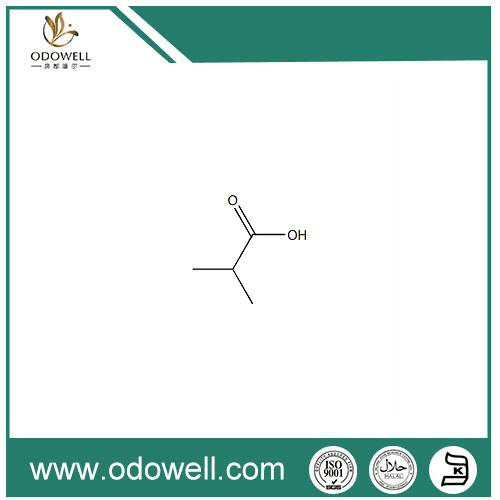
Isobutyric Acid
Isobutyric acid's cas code is 79-31-2
Isobutyric Acid, Suppliers, Wholesale, In Stock, Free Sample, China, Manufacturers, Made in China, Low Price, Quality, 1 Year Warranty
Product Description
Isobutyric acid Basic information
Chemical properties Uses Content analysis Toxicity Use limits Standard for Maximum Allowable Amount Production method Hazards & Safety Information
Product Name: | Isobutyric acid |
CAS: | 79-31-2 |
MF: | C4H8O2 |
MW: | 88.11 |
EINECS: | 201-195-7 |
Mol File: | 79-31-2.mol |
Isobutyric acid Chemical Properties
Melting point | -47 °C |
Boiling point | 153-154 °C(lit.) |
density | 0.95 g/mL at 25 °C(lit.) |
vapor density | 3.04 (vs air) |
vapor pressure | 1.5 mm Hg ( 20 °C) |
refractive index | n20/D 1.393(lit.) |
FEMA | 2222 | ISOBUTYRIC ACID |
Fp | 132 °F |
storage temp. | room temp |
solubility | 618g/l |
pka | 4.84(at 20℃) |
form | Liquid |
color | Clear colorless |
PH | 2.3 (500g/l, H2O, 25℃) |
Odor Threshold | 0.0015ppm |
explosive limit | 1.6-7.3%(V) |
Water Solubility | 210 g/L (20 ºC) |
JECFA Number | 253 |
Merck | 14,5155 |
BRN | 635770 |
InChIKey | KQNPFQTWMSNSAP-UHFFFAOYSA-N |
CAS DataBase Reference | 79-31-2(CAS DataBase Reference) |
NIST Chemistry Reference | Propanoic acid, 2-methyl-(79-31-2) |
EPA Substance Registry System | Isobutyric acid (79-31-2) |
Isobutyric acid Safety Information
Hazard Codes | Xn |
Risk Statements | 21/22 |
Safety Statements | 23-36/37/39-24/25 |
RIDADR | UN 2529 3/PG 3 |
WGK Germany | 1 |
RTECS | NQ4375000 |
F | 13 |
Autoignition Temperature | 824 °F |
TSCA | Yes |
HazardClass | 3 |
PackingGroup | III |
HS Code | 29156000 |
Hazardous Substances Data | 79-31-2(Hazardous Substances Data) |
Toxicity | LD50 orally in Rabbit: 266 mg/kg LD50 dermal Rabbit 475 mg/kg |
Isobutyric acid Usage And Synthesis
Chemical properties | Colorless oily liquid; strong irritating odor; miscible with water; soluble in alcohol, ether and so on. |
Content analysis | Determined by the same content analysis method of "butyric acid (03454)". |
Toxicity | GRAS (FEMA). |
Use limits | FEMA (mg/kg): soft drinks 4.1; cold drinks 12; candy 41; baked food 38; gummy candy 470; margarine 30. |
Production method | The preparation of isobutyric acid is similar with butyric acid, which is performed by the direct oxidation of isobutyl alcohol and isobutyraldehyde. Isobutyric acid can be directly generated from the oxidation of isobutyraldehyde in air or oxygen. Other manufacturing methods have isobutyronitrile hydrolysis and methacrylic acid hydrogenation. The oxidation of 2-methyl-1-nitropropane to prepare isobutyric acid can also obtain a higher yield. The purification of Isobutyric acid can be realized by azeotropic distillation with water, and anhydrous isobutyric acid can be obtained by the extractive distillation from carbon tetrachloride. Propylene and formic acid ester can react at 50 °C with the catalysis of hydrofluoric acid to generate methyl isobutyrate and propyl isobutyrate. |
Hazards & Safety Information | Production method :Isobutyric acid can be derived from the oxidation of isobutanol. |
Description | Isobutyric acid has an odor and flavor similar to n-butyric acid. Prepared via oxidation of isobutyl alcohol. |
Chemical Properties | Isobutyric acid has strong penetrating odor of rancid butter. The odor and flavor are similar to n-butyric acid. |
Chemical Properties | clear colorless liquid |
Uses | Isobutyric Acid is a flavoring agent that is a colorless liquid with a strong, penetrating odor, resembling butter. it is miscible in alcohol, propylene glycol, glycerin, mineral oil, and most fixed oils and sol- uble in water. it is obtained by chemical synthesis. it is also termed isopropylformic acid. |
Uses | Manufacture of esters for solvents, flavors and perfume bases, disinfecting agent, varnish, deliming hides, tanning agent. |
Definition | ChEBI: A branched fatty acid comprising propanoic acid carrying a methyl branch at C-2. |
Preparation | By oxidation of isobutyl alcohol. |
Aroma threshold values | Detection: 10 ppb to 9.5 ppm; aroma characteristics at 10 ppm: acidic pungent, dairy buttery and cheesy with fruity undertones. |
Taste threshold values | Taste characteristics at 15 ppm: acidic, sour dairy, creamy, cheese, cultured dairy nuance. |
General Description | A colorless liquid with a light odor of rancid butter. Flash point 132°F. Density 7.9 lb / gal. Corrosive to metals and tissue. |
Air & Water Reactions | Flammable. Water soluble |
Reactivity Profile | Isobutyric acid corrodes aluminum and other metals. Flammable hydrogen gas may accumulate in enclosed spaces in which this reaction has taken place [USCG, 1999]. |
Hazard | Toxic by ingestion, strong irritant to tissue. |
Health Hazard | Inhalation causes irritation of nose and throat. Ingestion causes irritation of mouth and stomach. Contact with eyes or skin causes irritation. |
Fire Hazard | Flammable/combustible material. May be ignited by heat, sparks or flames. Vapors may form explosive mixtures with air. Vapors may travel to source of ignition and flash back. Most vapors are heavier than air. They will spread along ground and collect in low or confined areas (sewers, basements, tanks). Vapor explosion hazard indoors, outdoors or in sewers. Runoff to sewer may create fire or explosion hazard. Containers may explode when heated. Many liquids are lighter than water. |
Purification Methods | Distil the acid from KMnO4, then redistil it from P2O5. [Beilstein 2 H 288, 2 I 126, 2 II 257, 2 III 637, 2 IV 843.] |
Isobutyric acid Preparation Products And Raw materials
Preparation Products | Permethrin-->Gemfibrozil-->Captopril-->Isobutyryl chloride-->Isobutyric anhydride-->Ethofenprox-->ethyl 3,3-dimethylpent-4-en-1-oate-->4-(3-ISOPROPYL-1,2,4-OXADIAZOL-5-YL)PIPERIDINE-->Methyl isobutyrate-->tert-Butyl peroxypivalate-->ethyl 4,6,6-trichloro-3,3-dimethyl-hex-5-enoate-->Isobutyramide-->Benzyl isobutyrate-->Isobutyl formate-->2-(4-Ethoxyphenyl)-2-methylpropanol-->Ethyl isobutyrate-->CITRONELLYL ISOBUTYRATE-->2-Bromo-2-methylpropionyl bromide-->Ethyl 2-(2-aminothiazole-4-yl)-2-(1-tert-butoxycarbonyl-1-methylethoxyimino)acetate-->Phenoxyethyl isobutyrate-->Butyl isobutyrate-->P-TOLYL ISOBUTYRATE-->Phenethyl isobutyrate-->OCTYL ISOBUTYRATE-->HEPTYL ISOBUTYRATE-->CINNAMYL ISOBUTYRATE-->Ethyl 2-bromoisobutyrate-->Hexyl isobutyrate |
Raw materials | Carbon tetrachloride-->Hydrazinium hydroxide-->Hydrofluoric acid-->2-Methyl-1-propanol-->(3R,4S)-1-Benzoyl-3-(1-methoxy-1-methylethoxy)-4-phenyl-2-azetidinone-->Methacrylic acid-->Isobutyraldehyde-->(-)-MENTHYL CHLOROFORMATE-->Isobutyronitrile-->Diazinon-->Propyl gallate-->1-Nitropropane-->BUTYRAMIDINE-->Methyl isobutyrate-->AROMA-->Isopentyl isobutyrate-->Benzyl isobutyrate-->OCTYL ISOBUTYRATE |