
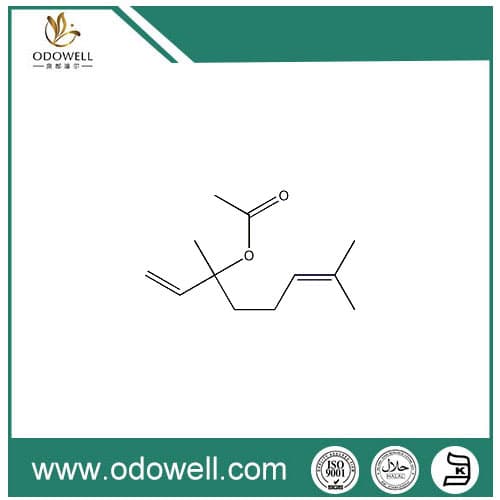
Linalyl Acetate
Linalyl acetate's cas code is 115-95-7
Linalyl Acetate, Suppliers, Wholesale, In Stock, Free Sample, China, Manufacturers, Made in China, Low Price, Quality, 1 Year Warranty
Product Description
Linalyl acetate Basic information
Description Reference
Product Name: | Linalyl acetate |
Synonyms: | high quality Linalyl acetate 115-95-7 kf-wang(at)kf-chem.com;1,6-Octadien-3-ol,3,7-dimethyl-,acetate;6-octadien-3-ol,3,7-dimethyl-acetate;Acetic acid linalool ester;aceticacidlinaloolester;Bergamiol;Bergamol;Bergamot mint oil |
CAS: | 115-95-7 |
MF: | C12H20O2 |
MW: | 196.29 |
EINECS: | 204-116-4 |
Product Categories: | Acyclic Monoterpenes;Biochemistry;Terpenes;ester Flavor |
Mol File: | 115-95-7.mol |
Linalyl acetate Chemical Properties
Melting point | 85°C |
Boiling point | 220 °C(lit.) |
density | 0.901 g/mL at 25 °C(lit.) |
vapor density | 6.8 (vs air) |
vapor pressure | 0.1 mm Hg ( 20 °C) |
refractive index | n20/D 1.453(lit.) |
FEMA | 2636 | LINALYL ACETATE |
Fp | 194 °F |
storage temp. | 2-8°C |
form | Liquid |
color | Clear colorless |
Water Solubility | 499.8mg/L(25 ºC) |
JECFA Number | 359 |
Merck | 14,5496 |
BRN | 1724500 |
InChIKey | UWKAYLJWKGQEPM-LBPRGKRZSA-N |
CAS DataBase Reference | 115-95-7(CAS DataBase Reference) |
NIST Chemistry Reference | 1,6-Octadien-3-ol, 3,7-dimethyl-, acetate(115-95-7) |
EPA Substance Registry System | Linalyl acetate (115-95-7) |
Linalyl acetate Safety Information
Hazard Codes | Xi |
Risk Statements | 36/37/38-38 |
Safety Statements | 26-36-37-24/25 |
RIDADR | NA 1993 / PGIII |
WGK Germany | 1 |
RTECS | RG5910000 |
HS Code | 29153900 |
Hazardous Substances Data | 115-95-7(Hazardous Substances Data) |
Toxicity | LD50 orally in Rabbit: 13934 mg/kg |
Linalyl acetate Usage And Synthesis
Description | Linalyl acetate belongs to monoterpene compound. It is a naturally occurring phytochemical found in many flowers and spice plants. It is the one of the principle components of essential oils of bergamont and lavender.1 It is a clear, colorless liquid with a boiling point of 220°C. Chemically, it is the acetate ester of linalool, and the two often occur in conjunction in the essential oils of Lavender and Lavandin.2 |
Reference | 1. https://pubchem.ncbi.nlm.nih.gov/compound/linalyl_acetate#section=Top 2. A. Martin, V. Silva, L. Perez, J. Garcia-Serna, M. J. Cocero, Direct Synthesis of Linalyl Acetate from Linalool in Supercritical Carbon Dioxide: A Thermodynamic Study, Chemical Engineering & Technology, 2007, vol. 30, pp. 726-731 3. H. Surbung, J. Panten, Common Fragrance and Flavor Materials: Preparation, Properties und Uses, 2006, ISBN 978-3-527-31315-0 4. C. S. Letizia, J. Cocchiara, J. Lalko, A. M. Api, Fragrance material review on linalyl acetate, Food and Chemical Toxicology, 2003, vol. 41, pp. 965-976 |
Description | Linalyl acetate has a characteristic bergamot-lavender odor and persistent sweet, acrid taste. |
Chemical Properties | Linalyl acetate has a characteristic bergamot–lavender odor and persistent sweet, acrid taste. |
Chemical Properties | CLEAR COLOURLESS LIQUID |
Chemical Properties | Linalyl Acetate occurs as its (?) isomer as the main component of lavender oil (30–60%, depending on the origin of the oil), of lavandin oil (25–50%, depending on the species), and of bergamot oil (30–45%). It has also been found in clary sage oil (up to 75%) and in a small amount in many other essential oils. Racemic linalyl acetate is a colorless liquid with a distinct bergamot–lavender odor. |
Uses | In perfumery. |
Aroma threshold values | Detection: 1 ppm |
Taste threshold values | Taste characteristics at 5 ppm: floral, green, waxy, terpy, citrus, herbal and spicy nuances. |
Contact allergens | Structurally close to linalool, linalyl acetate is the main component of lavender oil and is commonly used in fragrances and toiletries, and in household cleaners and detergents as well. By autoxidation, it leads mainly to hydroperoxides, with a high sensitizing potent. |
Chemical Synthesis | Normally prepared by direct acetylation of linalool; another method starts from myrcene hydrochloride, anhydrous sodium acetate and acetate anhydride in the presence of a catalyst; all synthetic methods tend to avoid the simultaneous formation (because of isomerization) of terpenyl and geranyl acetate. |
Linalyl acetate Preparation Products And Raw materials
Raw materials | Acetic acid glacial-->Sodium carbonate-->Potassium carbonate-->Linalool-->ketene-->Eucalyptus Citriodara Oil-->Clove oil-->Salvia Root P.E Tanshinone IIA 20%-->1,1,3,3,5-PENTAMETHYL-4,6-DINITROINDANE |
Preparation Products | Bergamot mint oil-->BERGAMOT OIL |