
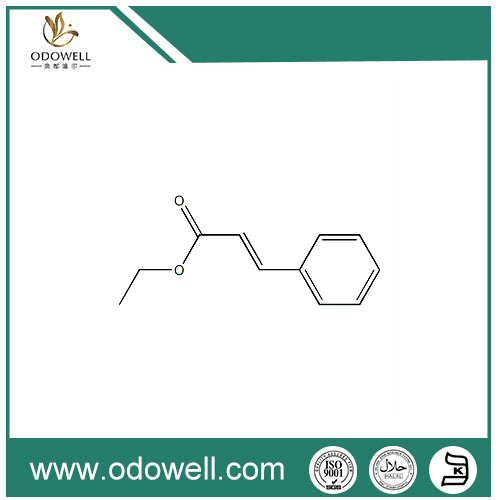
Natural Ethyl Cinnamate
Natural Ethyl cinnamate 's cas code is 103-36-6
Natural Ethyl Cinnamate, Suppliers, Wholesale, In Stock, Free Sample, China, Manufacturers, Made in China, Low Price, Quality, 1 Year Warranty
Product Description
Natural Ethyl cinnamate Basic information
Application of spices and fragrance Content analysis Toxicity Use the limit Maximal allowable amount as additive and maximal allowable residue Chemical properties Uses Production method
Product Name: | Natural Ethyl cinnamate |
CAS: | 103-36-6 |
MF: | C11H12O2 |
MW: | 176.21 |
EINECS: | 203-104-6 |
Mol File: | 103-36-6.mol |
Natural Ethyl cinnamate Chemical Properties
Melting point | 6-8 °C(lit.) |
Boiling point | 271 °C(lit.) |
density | 1.049 g/mL at 20 °C(lit.) |
FEMA | 2430 | ETHYL CINNAMATE |
refractive index | n20/D 1.558(lit.) |
Fp | >230 °F |
storage temp. | Refrigerator (+4°C) |
form | Liquid |
color | Clear colorless to pale yellow |
Water Solubility | insoluble |
Merck | 14,2299 |
JECFA Number | 659 |
BRN | 1238804 |
Stability: | Stable. Incompatible with strong oxidizing agents, acids, bases, reducing agents. Combustible. |
CAS DataBase Reference | 103-36-6(CAS DataBase Reference) |
NIST Chemistry Reference | trans-Ethyl cinnamate(103-36-6) |
EPA Substance Registry System | Ethyl cinnamate (103-36-6) |
Natural Ethyl cinnamate Safety Information
Risk Statements | 20-22 |
Safety Statements | 23-24/25 |
WGK Germany | 1 |
RTECS | GD9010000 |
TSCA | Yes |
HS Code | 29163990 |
Natural Ethyl cinnamate Usage
Description | Ethyl cinnamate is the ester of cinnamic acid and ethanol. It is present in the essential oil of cinnamon. Pure ethyl cinnamate has a "fruity and balsamic odor, reminiscent of cinnamon with an amber note". |
Chemical Properties | Ethyl cinnamate has a sweet balsami honey-note odor. |
Chemical Properties | colourless liquid |
Occurrence | Normally occurring in the trans-form; a cis-form also exists. Reported found in Oriental styrax, in the oil of Campheria galanga and in the rhizomes of Hedychium spicatum. Also reported found in cherry, American cranberry, pineapple, guava, strawberry, fresh blackberry, strawberry jam, soybean, yellow passion fruit juice, hybrid passion fruit juice, apple brandy, quince, prickly pear, strawberry wine, Bourbon vanilla, sea buckthorn, cinnamon leaf and root bark, clove, brandy, rum, sherry, grape wines, cocoa, soybean and other natural sources. |
Uses | Perfumery, flavoring extracts. |
Aroma threshold values | Detection: 17 to 40 ppb |
Taste threshold values | Taste characteristics at 20 ppm: balsamic, powdery, fruity, berry, punch, spice, sweet and green. |
Safety Profile | Moderately toxic by ingestion. Combustible liquid. When heated to decomposition it emits acrid smoke and irritating fumes. See also ESTERS |