
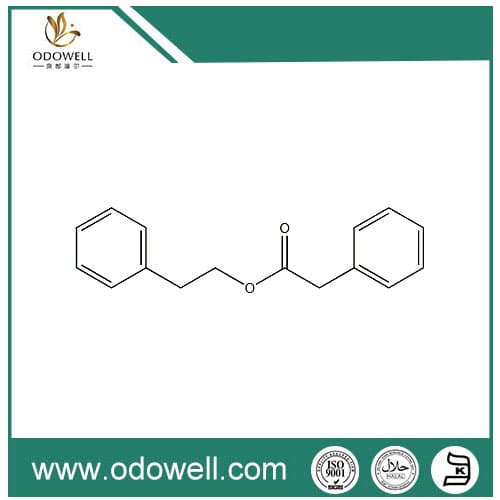
Natural Phenethyl Phenylacetate
Natural phenethyl phenylacetate's cas code is 102-20-5
Natural Phenethyl Phenylacetate, Suppliers, Wholesale, In Stock, Free Sample, China, Manufacturers, Made in China, Low Price, Quality, 1 Year Warranty
Product Description
Natural phenethyl phenylacetate Basic information
Product Name: | Natural phenethyl phenylacetate |
CAS: | 102-20-5 |
MF: | C16H16O2 |
MW: | 240.3 |
EINECS: | 203-013-1 |
Product Categories: | API intermediates |
Mol File: | 102-20-5.mol |
Natural phenethyl phenylacetate Chemical Properties
Melting point | 28 °C(lit.) |
Boiling point | 325 °C(lit.) |
density | 1.082 g/mL at 25 °C(lit.) |
FEMA | 2866 | PHENETHYL PHENYLACETATE |
refractive index | n20/D 1.55(lit.) |
Fp | >230 °F |
color | Colorless to sltly yellow liquid |
Odor | rosy, hyacinth odor |
JECFA Number | 999 |
CAS DataBase Reference | 102-20-5(CAS DataBase Reference) |
NIST Chemistry Reference | Benzeneacetic acid, 2-phenylethyl ester(102-20-5) |
EPA Substance Registry System | Benzeneacetic acid, 2-phenylethyl ester (102-20-5) |
Natural phenethyl phenylacetate Safety Information
Hazard Codes | Xi |
Risk Statements | 36/38 |
Safety Statements | 26-36 |
WGK Germany | 2 |
RTECS | AJ3255000 |
HS Code | 29163990 |
Toxicity | LD50 orl-rat: 15 g/kg FCTXAV 2,327,64 |
Natural phenethyl phenylacetate Usage
Chemical Properties | Colorless to pale yellow liquid or crystalline solid |
Chemical Properties | Phenylethyl Phenylacetate has been identified in, for example, the flower concrete of Michelia champaca L. It is a colorless liquid or in the form of crystals (mp 26.5°C), which have a heavy, sweet, rose or hyacinth odor and a distinct honey note. The ester is used particularly in floral fragrance compositions and as a fixative. |
Chemical Properties | Phenethyl phenylacetate has a heavy, sweet, floral and balsamic odor, somewhat rosy and a sweet, honey-like flavor. |
Uses | Phenethyl Phenylacetate is a flavoring agent that is a colorless or pale yellow liquid, with an odor resembling roses and hyacinth, which becomes solid at <26°c (78.8°f). it is soluble in alcohol, insol- uble in water. it is obtained by chemical synthesis. |