
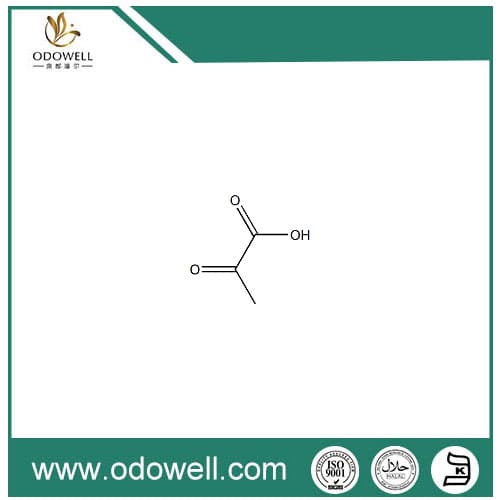
Natural Pyruvic Acid
Natural pyruvic acid 's cas code is 127-17-3
Natural Pyruvic Acid, Suppliers, Wholesale, In Stock, Free Sample, China, Manufacturers, Made in China, Low Price, Quality, 1 Year Warranty
Product Description
Natural pyruvic acid Basic information
Product Name: | Natural pyruvic acid |
CAS: | 127-17-3 |
MF: | C3H4O3 |
MW: | 88.06 |
EINECS: | 204-824-3 |
Mol File: | 127-17-3.mol |
Natural pyruvic acid Chemical Properties
Melting point | 11-12 °C(lit.) |
Boiling point | 165 °C(lit.) |
density | 1.272 g/mL at 20 °C |
FEMA | 2970 | PYRUVIC ACID |
refractive index | n20/D 1.428(lit.) |
Fp | 183 °F |
storage temp. | 2-8°C |
solubility | Miscible with chloroform and methanol. |
pka | 2.39(at 25℃) |
form | Liquid |
color | Clear colorless to light yellow or amber |
PH | 1.2 (90g/l, H2O, 20℃) |
JECFA Number | 936 |
Merck | 14,8021 |
BRN | 506211 |
Stability: | Stable. Combustible. Incompatible with strong oxidizing agents, strong bases. Refrigerate. |
InChIKey | LCTONWCANYUPML-UHFFFAOYSA-N |
CAS DataBase Reference | 127-17-3(CAS DataBase Reference) |
NIST Chemistry Reference | Pyruvic acid(127-17-3) |
EPA Substance Registry System | Propanoic acid, 2-oxo- (127-17-3) |
Natural pyruvic acid Safety Information
Hazard Codes | C |
Risk Statements | 34 |
Safety Statements | 26-36/37/39-45-25-27 |
RIDADR | UN 3265 8/PG 2 |
WGK Germany | 3 |
RTECS | UZ0829800 |
Autoignition Temperature | 305 °C |
TSCA | Yes |
HazardClass | 8 |
PackingGroup | II |
HS Code | 29335995 |
Natural pyruvic acid Usage
Chemical Properties | Colorless to light yellow liquid |
Chemical Properties | Pyruvic acid has a sour, acetic odor (similar to acetic acid). It has a pleasant, sour taste with a burning, somewhat sweet note. |
Occurrence | Isolated from cane sugar fermentation broth and from a few plants; also reported found in peppermint, raw asparagus, leaves and stalk of celery, onion, rutabaga, milk, cream, buttermilk, wheaten bread, blue cheeses, cheddar cheese, cottage cheese, provolone cheese, yogurt, beef, Virginia tobacco, beer, white wine, botrytised wine, cocoa and sake. |
Uses | pyruvic acid is an alpha hydroxy acid that can be irritating and is considered difficult to work with. It has a larger molecular size than the most commonly used AHAs. Sodium pyruvate is more commonly used, and is an organic salt. |
Uses | Biochemical research. |