
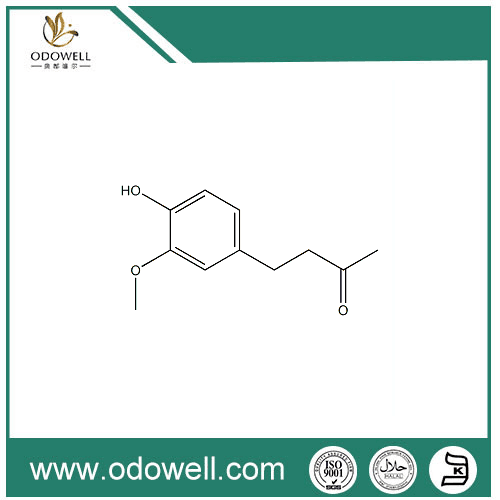
Zingerone
Zingerone's cas code is 122-48-5
Zingerone, Suppliers, Wholesale, In Stock, Free Sample, China, Manufacturers, Made in China, Low Price, Quality, 1 Year Warranty
Product Description
Zingerone Basic information
Food flavorings Content Analysis Toxicity Limited use
Product Name: | Zingerone |
Synonyms: | (0)-paradol;[0]-Paradol;3-Methoxy-4-hydroxybenzylacetone;3-methoxy-4-hydroxy-benzylacetone;4-(3-methoxy-4-hydroxyphenyl)-2-butanone;4-(4-hydroxy-3;Gingerone;zingerone [3-(4-hydroxy-3-methoxyphenyl)butan-2-one] |
CAS: | 122-48-5 |
MF: | C11H14O3 |
MW: | 194.23 |
EINECS: | 204-548-3 |
Product Categories: | Miscellaneous Natural Products;chemical reagent;pharmaceutical intermediate;phytochemical;reference standards from Chinese medicinal herbs (TCM).;standardized herbal extract;Inhibitors |
Mol File: | 122-48-5.mol |
Zingerone Chemical Properties
Melting point | 40-41 °C(lit.) |
Boiling point | 141 °C0.5 mm Hg(lit.) |
density | 1.14 g/mL at 25 °C(lit.) |
FEMA | 3124 | ZINGERONE |
refractive index | n20/D 1.541(lit.) |
Fp | >230 °F |
storage temp. | 2-8°C |
pka | 10.03±0.20(Predicted) |
JECFA Number | 730 |
Merck | 14,10166 |
InChIKey | OJYLAHXKWMRDGS-UHFFFAOYSA-N |
CAS DataBase Reference | 122-48-5(CAS DataBase Reference) |
NIST Chemistry Reference | 2-Butanone, 4-(4-hydroxy-3-methoxyphenyl)-(122-48-5) |
EPA Substance Registry System | 2-Butanone, 4-(4-hydroxy-3-methoxyphenyl)- (122-48-5) |
Zingerone Safety Information
Risk Statements | 36/37/38 |
Safety Statements | 26-36 |
WGK Germany | 2 |
RTECS | EL8900000 |
TSCA | Yes |
HS Code | 29333999 |
Hazardous Substances Data | 122-48-5(Hazardous Substances Data) |
Zingerone Usage And Synthesis
Food flavorings | Vanillylacetone also called zingerone , is a food spice which is allowed to be prepared appropriately according to production needs by Chinese "Sanitary Standards of Using Food Additives" (GB 2760-1996),its chemical name is 4-(4-hydroxy 3-methoxyphenyl)-2-butanone. Yellow or light amber crystal (acetone, petroleum ether or ethyl ether-petroleum ether), at room temperature, after long time ,it becomes to a viscous liquid.It has a strong irritating odor like spicy ginger and ginger-like pungent taste,it has a sweet, spicy, full-bodied and deep floral aroma, fragrance lasts for a long time. The relative density is 1.138~1.139 (25 ℃), melting point 40~41 ℃, boiling point 290 ℃ (102 ℃), refractive index 1.544~1.545. It can be dissolved in 50% ethanol in 1:1 ratio , slightly soluble in water and petroleum ether, soluble in dilute alkali. In the steam it slowly evaporates. When heated ,it can deoxidate silver nitrate ammonia solution; and it can react with an alcohol solution of ferric chloride to turn to green. It is derived from the Zingiber officinale essential oils , Vanillylacetone is the main constituent of ginger oil . After the condensation reaction of vanillin and acetone,it is obtained through hydrogenation .it is used as a full-bodied flavor sweeteners and edible flavorings. In the perfumed products ,it can have a "leather", "tobacco" flavor. It is not easy to change color. |
Content Analysis | Use gas chromatography (GT-10-4) nonpolar column method for the determination. |
Toxicity | GRAS (FEMA). |
Limited use | FEMA (mg/kg): Soft drinks 6.9; cold:7.8 ; confectionery, bakery products, 11.0; Chewing Gum:15.0 |
Chemical Properties | White solid. Soluble in ether; sparingly soluble in water and petroleum ether. |
Chemical Properties | Zingerone has a strong, pungent odor reminiscent of ginger. It has a sharp taste, similar to ginger. |
Uses | Vanillylacetone is a phenolic compound that naturally occurs in cranberry and ginger. Studies shows that Vanillylacetone exhibits variable cytotoxic, cytoprotective and antioxidant activity against li ver and human tumor cells. Vanillylacetone is also used in herbal medicine for various purposes. |
Uses | In fragrances, flavors and cosmetics; in artificial spice oils. |
Definition | ChEBI: A ketone that is 4-phenylbutan-2-one in which the phenyl ring is substituted at positions 3 and 4 by methoxy and hydroxy groups respectively. The major pungent component in ginger. |
Preparation | By condensation of vanillin with acetone followed by hydrogenation. |
Aroma threshold values | Aroma characteristics at 10.0%: low impacting, creamy, spicy eugenol clove-like with a slight balsamic vanilla-like note. |
Taste threshold values | Taste characteristics at 80 ppm: spicy with a biting, lingering heat. Taste characteristics at 20 ppm in 5% sugar solution: smooth, sweet, creamy and warm, spicy clove with a slight lingering burning bite. |
Safety Profile | Moderately toxic by ingestion. A skin irritant. A flammable liquid. When heated to decomposition it emits acrid smoke and irritating fumes. |